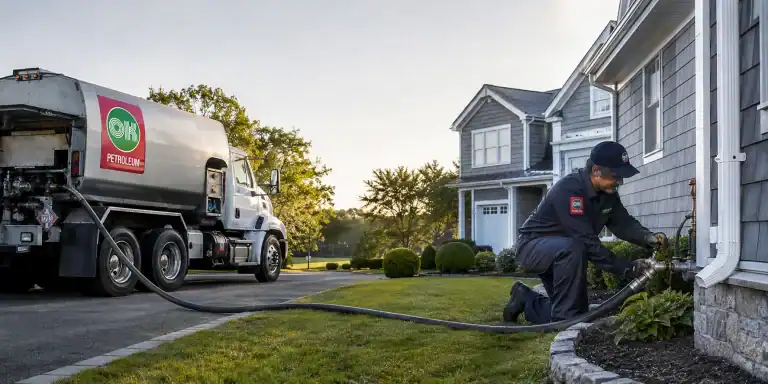



You got the oil delivered. The truck came, the tank is full, and you turned the thermostat back up. But nothing happened. No click, no rumble, no heat.
This is one of the most common — and most frustrating — surprises for Nassau County homeowners who run out of heating oil. The delivery fixes the fuel problem, but it doesn't automatically fix the furnace. There's a step in between that most oil companies never explain, and that leaves a lot of people standing in a cold house wondering what went wrong.
Here's what's actually going on, what you can do about it, and when you should stop and call someone.
Why Your Oil Furnace Won't Restart After Running Dry
When your oil tank runs completely empty, air gets pulled into the fuel line. That air creates a gap between the tank and the burner, and the burner can't fire without a steady flow of oil. Refilling the tank solves the supply problem, but the air is still in the line — and until that air is cleared out, your furnace isn't going anywhere.
This is the part that catches most people off guard. They assume the furnace will pick up where it left off once there's oil in the tank again. It won't — not reliably, and sometimes not at all without some intervention.
The Reset Button: What It Does and Why You Should Only Press It Once
The red reset button on your burner assembly is the first thing most homeowners reach for, and that instinct isn't wrong. Pressing it once sends a signal to the burner to attempt ignition. If there's enough oil in the line and the air pocket isn't too large, that single press is sometimes all it takes.
The problem is what happens when it doesn't work the first time. Most people press it again. And again. It's a completely understandable reaction — you're cold, you're frustrated, and the button is right there. But every time you press that reset without the furnace firing, you're sending more unburned oil into the combustion chamber. If the burner eventually does ignite with a chamber full of pooled oil, the result can be a puffback — an explosive release of soot and combustion gases that can damage your heating system and coat your ductwork in oily residue.
HVAC professionals are consistent on this point: press the reset button once, maybe twice, and stop. If the furnace doesn't respond, the problem isn't going to be solved by pressing it again. You've moved past the simple fix and into territory that needs a different approach.
This is especially relevant in Nassau County, where a significant portion of homes were built in the late 1940s and 1950s. Older oil burners — the kind you'll find in a post-war Cape Cod in Levittown or a split-level in Bethpage — can be more sensitive to this kind of misfire than newer equipment. Puffback events are most common in November through January, right when burners are being restarted after sitting dormant through the summer or after a first-of-season dry-tank event. If you notice an oil smell coming from the furnace area after a failed restart attempt, stop what you're doing and call a professional before trying anything else.
Bleeding the Fuel Line: When the Reset Button Isn't Enough
If one press of the reset button doesn't do it, the next step is bleeding the air out of the fuel line manually. This is a real procedure that a handy homeowner can do, but it requires the right tools and a clear understanding of what you're doing before you start.
You'll need an adjustable wrench or Allen key, a small container to catch waste oil, and a short length of quarter-inch nylon or rubber tubing. The bleeder valve — sometimes called a bleed screw — sits on the oil pump, which is part of the burner assembly. It typically looks like a small hex fitting, sometimes angled at about 45 degrees. You attach the tubing to the valve, hold the other end over your container, and slowly loosen the valve while the furnace is trying to run. Oil and air will begin to come out. Once you see a steady stream of oil with no air bubbles, tighten the valve back down and attempt a restart.
The whole process usually takes around five minutes if everything goes smoothly. But there are a few things worth knowing before you start.
First, wait at least five to ten minutes after your oil delivery before attempting any restart. When a nearly empty tank gets refilled, the incoming oil stirs up sediment that's settled at the bottom — sludge that accumulates over years of use. Giving it time to settle back down reduces the chance of drawing that material into the fuel line during your restart attempt.
Second, if you're dealing with an older Nassau County home — and the median build year here is 1955 — your oil tank may be carrying a meaningful amount of that sediment. Running the tank completely dry is harder on older systems than on newer ones, because the burner draws from the very bottom of the tank when the level gets low. That sludge can clog the fuel filter, the nozzle, or in more serious cases the fuel line itself. If you bleed the line and the furnace still won't start, or if it starts and then shuts off again shortly after, a clogged filter or nozzle is a likely culprit. That's a professional fix.
Third, if you don't have heating oil on hand and need to get heat going before a delivery arrives, kerosene or diesel fuel can serve as a temporary substitute. Add it to the tank, let it sit for ten minutes, then attempt your restart. It's not a long-term solution, but it's compatible with oil furnaces and safe to use in an emergency.
Restarting an Oil Boiler: A Few Key Differences
Not every Nassau County home heats with a forced-air furnace. Many of the county's older homes — particularly the two-story colonials and expanded Cape Cods in communities like Rockville Centre, Mineola, and Garden City — use hot-water boilers instead. The restart process is similar in most respects, but there are a couple of differences worth knowing.
The bleed valve on a boiler is typically located on the oil pump in the same general area as on a furnace burner, but the system itself distributes heat through radiators or baseboard units rather than ductwork. This means the heat takes longer to reach the living spaces even after a successful restart. Don't mistake a slow warm-up for a failed restart — give the system fifteen to twenty minutes before concluding something is wrong.
What a Professional Oil Heat Service Call Actually Involves
When an oil heat technician comes out to restart a system after a dry-tank event, they're doing more than pressing the reset button. A proper professional restart — sometimes called priming the burner — involves bleeding the air from the fuel line, inspecting and replacing the fuel filter if it's clogged with sediment, checking the nozzle for debris, and verifying that the oil pump is drawing correctly. On older systems, they may also check for worn components that a dry-run can accelerate.
This is worth understanding because it explains why some homeowners call for an oil delivery and still end up without heat. The delivery driver's job is to fill the tank. Priming and restarting the burner is a separate task — one that not every company handles as part of the delivery. If you've ever had oil delivered and then spent the next two hours on the phone trying to figure out why the heat still wasn't on, that's the gap you ran into.
When you call us for emergency delivery and mention that your tank ran dry, we'll either send someone who can handle the restart or connect you with a technician who can. That's not a standard practice across the industry — but it should be, and it's how we approach it. Nassau County's housing stock is old enough that a dry-tank event is rarely just an air-in-the-line problem. It often involves sediment, worn filters, and equipment that hasn't been serviced in a while. Treating it as a simple refill and walking away doesn't serve the customer.
The best way to avoid all of this, of course, is an annual burner tune-up before the heating season starts. A technician will clean the nozzle, replace the filter, check the pump, and make sure the system is ready to run efficiently through the winter. Homeowners who do this consistently are far less likely to face a complicated restart situation — whether or not they run out of oil.
Emergency Fuel Oil Delivery in Nassau County: What to Know Before You Call
Nassau County is one of the most oil-heat-dependent markets in the country. Roughly 59% of Long Island homes run on heating oil — a direct reflection of the county's post-war housing boom, when natural gas infrastructure was limited and oil-fired systems were the standard. Most of those systems are still running today. That means when a cold snap hits in November or a nor'easter rolls through in January, the demand for emergency oil delivery across the county spikes fast.
If you're in that situation — tank empty, furnace not responding, temperatures dropping — here's what actually helps. Call as early in the day as you can. Emergency delivery availability tightens as the day goes on during high-demand periods, and same-day service is much easier to arrange at 9 a.m. than at 4 p.m. Have your address and approximate tank size ready. And as mentioned above, tell the dispatcher that your tank ran dry — not just that you need oil. That detail changes what kind of response you need.
For will-call customers who manage their own delivery timing, running out of oil is an occupational hazard of watching the gauge yourself. There's nothing wrong with that approach — it gives you control over timing and cost — but it does mean you need a reliable company you can reach quickly when the tank gets low. We've been serving Nassau County communities including Baldwin, Bellmore, Mineola, Plainview, Bethpage, and Carle Place for over 40 years, and emergency availability is part of how we operate.
If you'd rather not manage the tank level yourself, our automatic delivery program handles it for you. We use predictive computer models that track your household's consumption against actual weather data and schedule deliveries before your tank reaches a quarter full. For busy households, frequent travelers, or anyone who's had the experience of waking up to a cold house once and never wanting to repeat it, automatic delivery is worth considering. There are no contracts required to get started, and you can always adjust or switch back to will-call if your situation changes.
One more thing worth knowing: New York State requires that all heating oil delivered in Nassau County and other downstate counties contain at least 5% biodiesel — what's known as B5 bioheat. This isn't a choice your oil company makes; it's a state mandate. We supply B5-compliant heating oil as standard, and we also offer additional eco-friendly biofuel-based options for homeowners who want to go further. If you have an older oil tank, it's worth knowing that biodiesel blends can have a mild solvent effect on pre-existing sludge — another reason why running the tank completely dry and stirring up that sediment is something worth avoiding when possible.
What to Do When Your Furnace Won't Restart — and How to Avoid It Next Time
If your furnace isn't responding after an oil delivery, the short version is this: press the reset button once, wait, and see if it fires. If it doesn't, stop pressing and move to bleeding the fuel line — or call a professional if you're not comfortable doing it yourself. If the furnace starts and then shuts off again, or if you smell oil near the burner, stop and call a technician. Older systems in Nassau County's aging housing stock are more prone to the downstream effects of a dry-tank event than newer equipment, and the cost of a service call is a lot lower than the cost of a puffback or a damaged burner.
The bigger picture is that running out of heating oil is a solvable problem on both ends — before it happens and after. If you're ready to stop watching the gauge and wondering, or if you need emergency delivery and want a company that understands what comes after the truck leaves, reach out to OK Petroleum Distribution at (631) 321-0549. We've been doing this on Long Island for a long time, and we're not going anywhere.